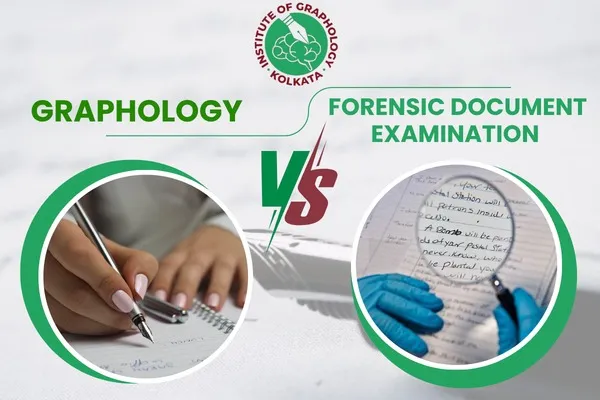
Graphology vs. Forensic Document Examination: Understanding the Key Differences
Hello Reader!
Welcome to the blog page of Institute of Graphology, one of the best Graphology Institute in Kolkata.
In the world of handwriting analysis, two terms are often used interchangeably—Graphology and Forensic Document Examination. However, despite their apparent similarities, these two disciplines serve very different purposes. In this blog, we will explore Graphology vs. Forensic Document Examination in depth and help you understand how each field works, their applications, and why both are important in their own domains.
At the Institute Of Graphology, recognized as the Best Graphology Institute in Kolkata, we believe in spreading awareness about the true scope and value of handwriting analysis.
What is Graphology?
Graphology is the study of handwriting to analyze an individual’s personality traits, behavior, and emotional patterns. It is widely used in areas such as:
- Personality assessment
- Career guidance
- Relationship compatibility
- Psychological insights
- Recruitment and HR analysis
Graphology is based on the idea that handwriting is a reflection of the subconscious mind. Every stroke, curve, and spacing reveals something about a person’s inner world.
At the Best Graphology Institute in Kolkata, students are trained to decode these subtle patterns to provide meaningful insights into human behavior.
What is Forensic Document Examination?
Forensic Document Examination (FDE), on the other hand, is a scientific discipline used primarily in legal and criminal investigations. It focuses on:
- Verifying the authenticity of documents
- Detecting forgery or alterations
- Identifying handwriting in disputed cases
- Analyzing signatures for fraud detection
Unlike graphology, forensic document examination does not interpret personality. Instead, it relies on scientific methods and evidence-based analysis to establish facts that can stand in a court of law.

Graphology vs. Forensic Document Examination: Key Differences
1. Purpose
- Graphology: Focuses on understanding personality and behavior
- Forensic Document Examination: Focuses on legal verification and evidence
2. Application Areas
- Graphology: HR, counselling, personal development
- Forensic Document Examination: Courts, legal cases, criminal investigations
3. Nature of Analysis
- Graphology: Psychological and interpretative
- Forensic Document Examination: Scientific and technical
4. Outcome
- Graphology: Provides insights into traits like confidence, honesty, and emotional stability
- Forensic Document Examination: Determines authenticity, forgery, or authorship
5. Use of Tools
- Graphology: Relies on observation and psychological principles
- Forensic Document Examination: Uses microscopes, imaging tools, and lab techniques
Understanding Graphology vs. Forensic Document Examination helps clarify that while both involve handwriting, their objectives and methods are completely different.
Can Graphology and Forensic Examination Work Together?
Interestingly, both fields can complement each other. For instance:
- A forensic expert may identify a document as genuine
- A graphologist can then analyze the writer’s personality
This combination can be useful in corporate investigations, psychological profiling, and advanced research.
At the Best Graphology Institute in Kolkata, we emphasize the importance of understanding both domains to build a well-rounded knowledge base.
Why Learn Graphology Today?
With increasing interest in self-awareness and behavioral analysis, graphology is gaining popularity across industries. It is not only a powerful tool for understanding others but also for personal growth and career advancement.
By enrolling in the Best Graphology Institute in Kolkata, you can learn:
- Scientific techniques of handwriting analysis
- Practical applications in real-life scenarios
- Professional skills to build a career in graphology

What is graphotherapy and its benefits?
Graphotherapy involves consciously modifying specific handwriting elements—like slant, pressure, size, or letter forms—to reprogram subconscious patterns. For instance, writing with an upward slant might foster optimism, while wider spacing could promote better emotional boundaries. At the Best Graphology Institute in Kolkata, the Institute of Graphology, we teach this as a practical extension of graphology for self-improvement.
It works on the principle that handwriting mirrors brain activity, so altering strokes creates new neural pathways over time. Unlike talk therapy, it’s hands-on and self-directed with guidance.
Key Benefits
Graphotherapy offers targeted improvements across mental, emotional, and physical areas. Practitioners report measurable shifts after consistent practice.
- Boosts self-confidence and decision-making by strengthening assertive strokes.
- Reduces anxiety and stress, with some sources noting up to 80% improvement through calmer writing rhythms.
- Enhances concentration and clarity, ideal for students or professionals facing focus issues.
- Heals emotional traumas, like childhood wounds, by releasing blocked energy via fluid loops.
- Improves relationships and communication by softening shy or aggressive traits.
Practical Applications
Students use it for better academic performance, while adults apply it for career growth or emotional balance. It’s non-invasive, with no side effects, and complements other therapies.
| Issue | Graphotherapy Technique | Expected Outcome |
| Low Self-Esteem | Larger capitals, firm pressure | Heightened willpower |
| Anxiety | Even baseline, lighter pressure | Reduced tension |
| Poor Concentration | Narrow spacing, straight lines | Sharper focus |
| Shyness | Open loops, rightward slant | Better social confidence |
Getting Started
Begin with a handwriting analysis to identify changes, then practice daily exercises. The Institute of Graphology, the Best Graphology Institute in Kolkata, offers certified graphotherapy training tailored for these benefits. Related to our exploration of Graphology vs. Forensic Document Examination, this highlights graphology’s therapeutic side.
Also Read: What is Slanted Handwriting? What Does it Mean?

Can graphology be used alongside forensic analysis?
Graphology and forensic document examination are distinct fields, and graphology generally cannot be reliably used alongside forensic analysis due to its lack of scientific validity in legal contexts.
Core Distinctions Limit Integration
Traditional graphology infers personality from handwriting, while forensic analysis scientifically compares documents for authenticity. Courts reject graphology as evidence, likening it to astrology versus astronomy, with no place in forensic work.
Forensic experts emphasize objective metrics like stroke patterns, not subjective traits. Mixing them risks contaminating admissible evidence.
“Forensic Graphology” Debates
Some term “forensic graphology” for profiling suspects via handwriting traits like mood or integrity, aiding investigations in crimes like theft or murder. However, critics highlight its subjectivity, lack of standardization, and inadmissibility in court.
Research shows no empirical support for graphology in criminal profiling, favoring behavioral or linguistic methods. Professional bodies like ASQDE bar graphologists from forensic roles.
| Aspect | Graphology in Profiling | Forensic Document Examination |
| Scientific Validity | Low; subjective traits | High; empirical comparisons |
| Court Admissibility | Rejected | Accepted |
| Primary Use | Suspect insights (debated) | Forgery/authorship proof |
Practical Advice
In professional settings, keep graphology separate for therapy or HR, as at the Best Graphology Institute in Kolkata—the Institute of Graphology. For forensics, consult certified examiners only. This aligns with distinctions in Graphology vs. Forensic Document Examination.
Scientific validity of forensic handwriting analysis methods
Forensic handwriting analysis, part of forensic document examination, has demonstrated strong scientific validity through empirical studies, though it involves expert judgment and is not infallible.
Empirical Evidence of Accuracy
Large-scale black-box studies confirm high reliability: a 2022 PNAS study with 86 examiners on 7,196 comparisons found 88.3% correct associations on mated samples and 95.8% correct exclusions on non-mated ones, with low false positives (0.18%). Trained examiners outperform laypeople, achieving error rates under 5% in controlled tests.
Repeatability across examiners exceeds 90% for clear conclusions.
Legal Admissibility Standards
Under Daubert criteria, courts admit handwriting evidence due to its testability, peer review, and known error rates. Every U.S. circuit upholds it, viewing the method as reliable despite subjectivity.
Critics note PCAST concerns on foundational validity, but post-2016 research has bolstered acceptance.
| Metric (from 2022 Study) | Mated Samples (True Positive) | Non-Mated (True Negative) |
| Definite Correct | 54.0% | 94.5% |
| Probable Correct | 34.3% | 1.3% |
| Total Correct | 88.3% | 95.8% |
| False Positive Rate | – | 0.18% |
Methodological Strengths
Examiners analyze individual characteristics (e.g., letter formation, proportions) and class features (e.g., slant), using tools like electrostatic detection for overlaps. Bayesian reasoning avoids binary conclusions, enhancing objectivity.
Quality of exemplars affects outcomes, but protocols mitigate biases. Accuracy reaches 85-95% in practice.
Limitations and Ongoing Research
Human judgment introduces variability, prompting calls for more blind testing. Unlike DNA, no universal database exists, but advances in instrumentation improve precision. This contrasts sharply with graphology’s lack of validity, as discussed in Graphology vs. Forensic Document Examination.

Graphotherapy applications in a graphology institute
Graphotherapy applications in graphology institutes focus on handwriting exercises to foster personal growth, emotional healing, and skill enhancement through structured training.
Core Applications
Institutes like the Institute of Graphology, the Best Graphology Institute in Kolkata, integrate graphotherapy into courses for trait modification—boosting confidence, reducing stress, or improving focus. Students learn to prescribe exercises targeting issues like low self-esteem or anxiety via stroke changes.
It’s used for self-awareness, career counseling, and behavioral shifts, often with real-life case studies.
Educational and Therapeutic Uses
- Student Development: Aids learning difficulties, memory, and stress reduction through daily drills like S-shaped patterns.
- Adult Therapy: Addresses depression, allergies, or relationships; personalized online/in-person sessions.
- Corporate Training: Enhances leadership, patience, and finances via signature tweaks.
Certification programs (e.g., 6-hour online courses) include demos for professional practice.
Institute Programs
Graphology institutes offer pre-recorded lectures, practical assessments, and networking. The Best Graphology Institute in Kolkata provides offline graphotherapy from January 2026, plus grapho-counseling.
| Application Area | Techniques Used | Target Benefits |
| Child Learning | Stress-reducing loops, even baselines | Better memory, reduced anxiety |
| Emotional Health | Open forms, lighter pressure | Confidence, calm |
| Professional Growth | Firm strokes, wider spacing | Leadership, focus |
Integration with Graphology
Following Graphology vs. Forensic Document Examination, institutes emphasize therapeutic uses, distinct from forensics. Enroll at the Institute of Graphology for hands-on graphotherapy to reshape behaviors ethically.

What distinguishes graphology from forensic document examination?
Graphology and forensic document examination both involve handwriting analysis but differ fundamentally in purpose, methods, and scientific standing.
Purpose and Goals
Graphology interprets handwriting to assess personality traits, emotions, and behaviors, often for personal development or hiring. Forensic document examination (FDE) determines document authenticity, authorship, or forgery detection for legal evidence.
These goals never overlap: graphology seeks psychological insights; FDE provides court-admissible proof.
Methodologies
Graphology uses subjective, holistic interpretations of features like slant or pressure for trait inference. FDE applies objective, measurable comparisons—stroke sequence, proportions, pen lifts—across multiple samples, often with magnification or chemical tests.
Trained FDE examiners follow standardized protocols; graphologists rely on personal judgment.
Scientific Validity
FDE meets Daubert standards with empirical error rates under 5% in black-box studies. Graphology lacks validation, akin to pseudoscience, and courts reject it outright.
| Feature | Graphology | Forensic Document Examination |
| Approach | Subjective, interpretive | Objective, scientific |
| Key Focus | Personality traits | Authenticity/forgery |
| Court Use | None | Standard |
| Training | Varied, non-regulated | Certified, formal |
Practical Implications
At the Best Graphology Institute in Kolkata, the Institute of Graphology, we focus on ethical graphology applications like graphotherapy, distinct from FDE. This separation upholds Graphology vs. Forensic Document Examination integrity.

FAQ
1. What is the main difference in Graphology vs. Forensic Document Examination?
Graphology focuses on analyzing personality traits through handwriting, while forensic document examination focuses on verifying authenticity and detecting forgery for legal purposes.
2. Is graphology used in legal cases like forensic document examination?
No, graphology is generally not accepted as legal evidence, whereas forensic document examination is widely used in courts and criminal investigations.
3. Can graphology and forensic document examination be used together?
Yes, they can complement each other—forensic experts verify documents, and graphologists can provide behavioral insights about the writer.
4. Which field is more scientific—Graphology or Forensic Document Examination?
Forensic document examination is considered more scientific and evidence-based, while graphology is interpretative and psychological in nature.
5. Who should learn graphology vs. forensic document examination?
Graphology is ideal for those interested in personality analysis, counselling, or HR, while forensic document examination is suited for those aiming for a career in law enforcement or forensic science.
Conclusion
To summarize, Graphology vs. Forensic Document Examination highlights two distinct yet fascinating fields. While graphology delves into the mind and personality, forensic document examination focuses on facts and legal authenticity.
Both disciplines play crucial roles in their respective areas, and understanding their differences can help you choose the right path—whether for career, knowledge, or personal interest.
If you are passionate about handwriting analysis and want to explore its deeper dimensions, the Institute Of Graphology, known as the Best Graphology Institute in Kolkata, is your ideal destination to begin your journey.