Is Your Signature Fake? Learn Detection from best graphology institute in Kolkata
Hello Reader!
Welcome to the blog page of the Institute of Graphology, one of the best Graphology Institute in Kolkata.
In today’s world, where signatures are widely used for legal, financial, and personal identification purposes, signature forgery has become a serious concern. From bank frauds and property disputes to cheque manipulation and contract tampering, forged signatures can lead to major legal and financial consequences. Understanding what signature forgery is and how to detect a forged signature is essential for individuals, businesses, and legal professionals alike.
At the Best Graphology Institute in Kolkata, we train professionals to scientifically analyze handwriting and signatures to identify authenticity and detect forgery with precision.

What is Signature Forgery?
Signature Forgery refers to the act of illegally copying or imitating another person’s signature with the intent to deceive. The goal of signature forgery is to make the forged signature appear genuine so that it can be used for unauthorized benefits.
A signature is not just a name written on paper—it reflects the writer’s motor habits, rhythm, pressure, speed, and emotional state. Because these elements are extremely difficult to replicate perfectly, signature forgery can be detected through professional handwriting analysis.
Common Types of Signature Forgery
At the Best Graphology Institute in Kolkata, we classify signature forgery into several categories:
1. Simple Forgery
This occurs when a person writes someone else’s name without trying to imitate the original signature. These forgeries are usually easy to detect.
2. Simulated Forgery
The forger practices copying the original signature multiple times to make it look similar. This type of signature forgery is more advanced and requires expert analysis.
3. Traced Forgery
The original signature is traced using carbon paper, light boxes, or transparent sheets. Traced forgeries often lack natural writing flow.
4. Disguised Signature
Sometimes, a person deliberately alters their own signature to later deny it. This is common in legal disputes and is also considered a form of signature forgery.
Why is Signature Forgery a Serious Issue?
Signature forgery can lead to:
- Financial fraud
- Property and inheritance disputes
- False legal agreements
- Identity theft
- Loss of credibility and trust
That is why professional examination from experts trained at the Best Graphology Institute in Kolkata becomes crucial in disputed cases.
Also Read: Where is Forensic Handwriting Analysis Used?

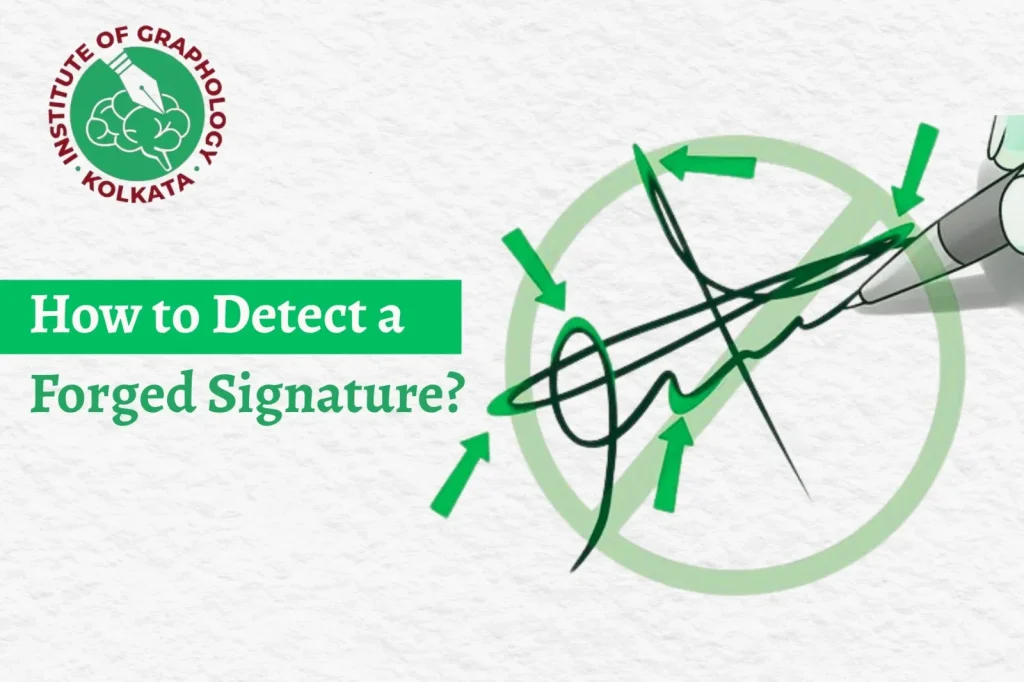
How to Detect a Forged Signature?
Detecting signature forgery requires scientific observation, comparison, and expert interpretation. Below are key indicators professionals use:
1. Line Quality
Genuine signatures flow smoothly, while forged signatures often show:
- Shaky or tremulous lines
- Uneven strokes
- Slow and hesitant movement
Forgers focus on appearance rather than natural motion.
2. Pen Pressure
Authentic signatures have consistent pressure patterns. In signature forgery:
- Pressure may appear unusually light or heavy
- Pressure changes suddenly at certain points
These inconsistencies reveal lack of motor control.
3. Speed and Rhythm
Natural signatures are written quickly and confidently. Forged signatures are often:
- Slow and cautious
- Lacking rhythm and spontaneity
This is a major red flag in signature forgery detection.
4. Letter Formation
Forged signatures may show:
- Incorrect letter shapes
- Awkward curves or angles
- Poor proportion between letters
At the Best Graphology Institute in Kolkata, students learn how micro-details reveal forgery.
5. Spacing and Alignment
Spacing between letters and words in genuine signatures remains fairly consistent. In signature forgery, spacing may look forced or irregular.
6. Beginning and Ending Strokes
Forgers often struggle with:
- Natural entry strokes
- Confident finishing strokes
End strokes may appear blunt, hesitant, or abruptly stopped.
7. Retouching and Corrections
Signs of overwriting, patching, or retracing indicate traced or simulated signature forgery.
8. Overall Naturalness
A genuine signature looks effortless. A forged one often looks “drawn” rather than written.

Role of Graphology in Detecting Signature Forgery
Graphology plays a crucial role in forensic handwriting examination. A trained graphologist studies:
- Motor skills
- Habitual writing patterns
- Subconscious movements
At the Best Graphology Institute in Kolkata, we provide in-depth training in forensic graphology, signature verification, and document examination.
When Should You Consult a Signature Forgery Expert?
You should seek expert help if:
- A signature is disputed in court
- Financial fraud is suspected
- Property documents are questioned
- Cheque or will authenticity is challenged
Professional analysis from experts trained at the Best Graphology Institute in Kolkata can provide reliable opinions backed by scientific methodology.
Learn Signature Forgery Detection Professionally
If you are interested in learning how to identify signature forgery, pursuing professional training is essential. Our Institute of Graphology offers structured courses designed to build strong analytical skills and real-world application.
As a leading authority and Best Graphology Institute in Kolkata, we focus on practical learning, case studies, and expert guidance under experienced graphologists.

Common Myths About Signature Forgery
Common myths about signature forgery often mislead people, leading to overlooked fraud or false accusations in legal and personal matters. Dr. Rupa Talukdar at the Institute of Graphology, the Best Graphology Institute in Kolkata, debunks these through expert training on signature forgery detection.
Myth 1: Perfect Copies Are Impossible to Detect
Many believe a skilled forger can create an undetectable replica, but graphology reveals subtle tremors, inconsistent pressure, and unnatural rhythm even in “perfect” copies. Genuine signatures flow unconsciously with speed and fluidity, while forgeries show hesitation detectable via magnification.
Myth 2: Forgery Always Looks Obviously Shaky
People assume all forged signatures tremble visibly, yet skilled signature forgery can mimic smoothness; experts spot it through proportion mismatches and pen lifts invisible to the untrained eye. At the Best Graphology Institute in Kolkata, courses teach these nuances for accurate signature forgery analysis.
Myth 3: Anyone Can Spot Forgery with the Naked Eye
A common misconception holds that simple visual comparison suffices, but dynamic factors like stroke speed and acceleration require forensic tools and graphology training. Traced signature forgery often hides double ink lines without expert scrutiny, as emphasized in programs at the Institute of Graphology.
Myth 4: Digital Signatures Eliminate Signature Forgery Risks
While digital methods reduce some threats, myths ignore copy-paste or biometric bypass forgeries; hybrid graphology verifies both traditional and electronic signature forgery effectively. Training at the Best Graphology Institute in Kolkata covers these modern challenges comprehensively.
Tools Used in Signature Forgery Detection
Dr. Rupa Talukdar at the Institute of Graphology, the Best Graphology Institute in Kolkata, emphasizes mastering tools for signature forgery detection to ensure accuracy in forensic and legal contexts.
Microscopes and Magnifiers
Microscopic examination reveals hidden pen lifts, ink pooling, and tracing marks invisible to the naked eye, crucial for identifying traced signature forgery. Experts use digital microscopes for high-resolution imaging of stroke thickness and pressure variations.
Pressure Sensitivity Tools
Devices like the electrostatic detection apparatus (ESDA) map pen pressure and indentations, exposing unnatural uniformity in forged signatures compared to genuine fluid dynamics. These tools are staples in graphology training at the Best Graphology Institute in Kolkata.
Digital Software and AI Analyzers
AI-powered software performs biometric comparisons of speed, rhythm, and slant, flagging anomalies in signature forgery with machine learning models trained on vast datasets. Video spectral comparators overlay samples for precise overlay analysis.
Handwriting Comparison Kits
Side-by-side comparison charts and overlay transparencies highlight discrepancies in proportions and alignment, enhanced by UV lights for ink age detection. Programs at the Institute of Graphology teach these for professional signature forgery cases.
Advanced Graphology Techniques to Spot Signature Forgery
Advanced graphology techniques enable precise signature forgery detection by analyzing subtle handwriting dynamics beyond basic visual checks. Dr. Rupa Talukdar at the Institute of Graphology, the Best Graphology Institute in Kolkata, trains professionals in these methods for forensic reliability.
Stroke Dynamics Analysis
Examine acceleration, deceleration, and rhythm in strokes; genuine signatures show rapid, unconscious fluency, while signature forgery exhibits pauses and retouches detectable through speed curve plotting. Graphologists measure tremor frequency and amplitude for forgery indicators like unnatural hesitation.
Proportional and Spatial Metrics
Compare letter heights, widths, baselines, and spacing ratios across samples; forgeries often distort proportions due to conscious copying, unlike natural variability in authentic ones. Advanced overlay techniques quantify slant consistency and loop formations at the Best Graphology Institute in Kolkata.
Pressure Pattern Mapping
Graphology reveals forgery via irregular pressure gradients—genuine signatures have smooth transitions, but traced or freehand signature forgery shows blunt starts, patchy shading, or double lines under angled lighting. Electrostatic tools enhance this for court-admissible evidence.
Holistic Behavioral Profiling
Integrate personality traits from handwriting (e.g., pressure for energy levels) with signature forgery checks; mismatches in fluency or connectivity signal imitation. Training at the Institute of Graphology, the Best Graphology Institute in Kolkata, combines these for comprehensive analysis in legal disputes.
Legal Consequences of Signature Forgery in India
Signature forgery in India carries severe legal repercussions under the Indian Penal Code (IPC), designed to deter fraud in documents like cheques, wills, and property deeds. Dr. Rupa Talukdar at the Institute of Graphology, the Best Graphology Institute in Kolkata, often provides expert testimony in such cases to validate signature forgery claims.
Key IPC Sections and Penalties
Section 465 IPC punishes general forgery with up to 2 years imprisonment, fine, or both, while Section 467 escalates to life imprisonment or up to 10 years plus fine for forging valuable securities like wills or property documents. Section 468 addresses forgery for cheating with up to 7 years rigorous imprisonment and fine, and Section 471 penalizes using forged documents as genuine with equivalent punishments.
Aggravated Cases and Enhancements
Financial frauds involving signature forgery, such as cheque encashment or real estate deals, attract stricter penalties under Sections 466 (court records: up to 7 years) and 469 (harming reputation: up to 3 years). Courts consider intent, damage caused, and prior offenses, often mandating forensic graphology reports from experts trained at the Best Graphology Institute in Kolkata.
Procedural and Civil Ramifications
Victims file FIRs leading to police investigation and forensic handwriting analysis; convictions result in non-bailable warrants for serious cases. Civil remedies include document invalidation and compensation, with graphologists like Dr. Rupa Talukdar strengthening prosecutions through precise signature forgery detection.

FAQ
1. What is signature forgery?
Signature forgery is the act of illegally copying or imitating someone’s signature with the intention to deceive or commit fraud.
2. Why do people forge signatures?
Signatures are often forged for financial fraud, property disputes, legal manipulation, or unauthorized access to documents.
3. What are common signs of a forged signature?
Irregular strokes, uneven pressure, shaky lines, unnatural pauses, and differences in size or slant compared to the genuine signature are common indicators.
4. Can a forged signature be detected easily?
Some forgeries are obvious, but skilled forgeries may require expert examination using magnification, comparison techniques, and forensic tools.
5. Who can verify whether a signature is forged or genuine?
A forensic document examiner or handwriting expert can professionally analyze and confirm whether a signature is genuine or forged.
Conclusion
Signature forgery is a complex but detectable crime when examined scientifically. While forged signatures may appear convincing at first glance, they often fail to replicate the natural rhythm, pressure, and fluency of a genuine signature. Through proper training and expert analysis, forged signatures can be identified accurately.
If you wish to understand, detect, or professionally work with signature forgery, learning from the Best Graphology Institute in Kolkata can empower you with the right knowledge and skills.